Pre-Conference Short Courses

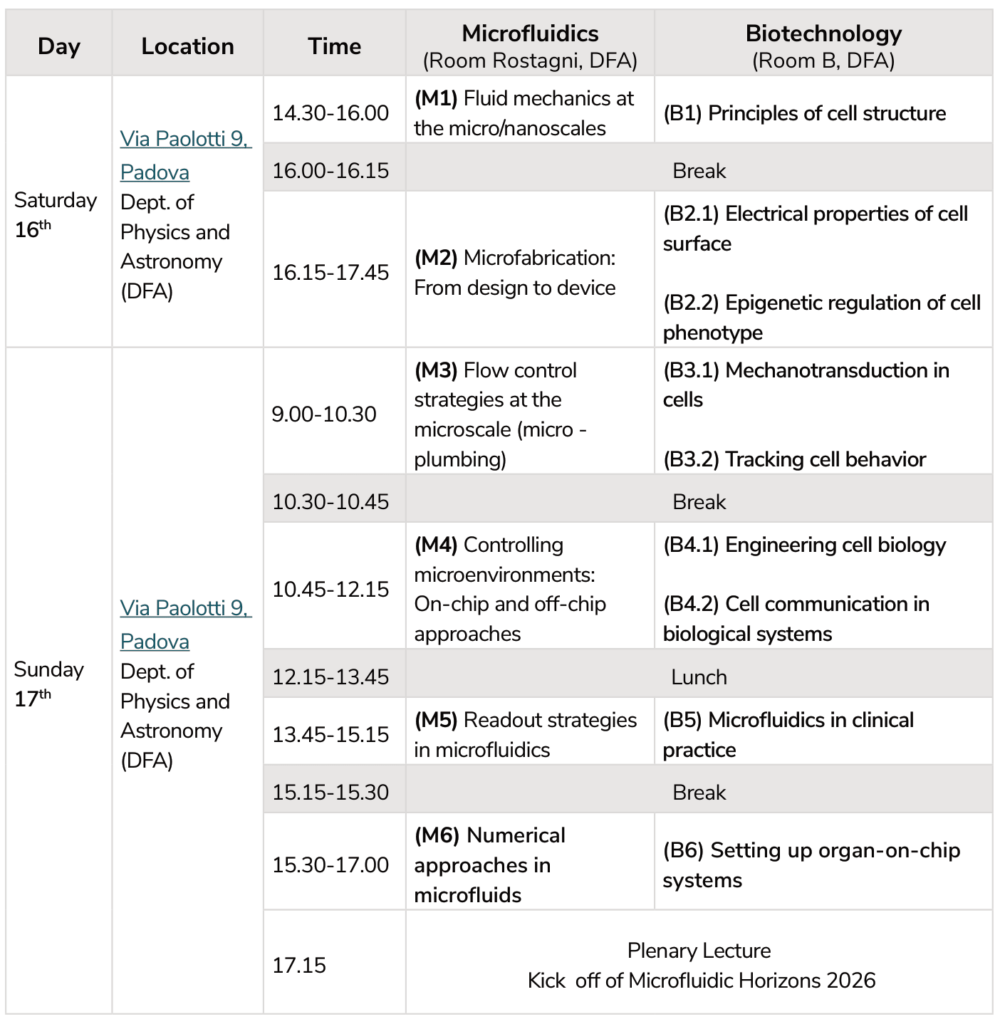
The Microfluidic Horizons 2026 conference will be preceded by a two-day series of Short Courses on May 16-17, 2026, hosted in the rooms of the Department of Physics and Astronomy “G. Galilei”, University of Padua. 

These Short Courses will cover the principles of microfluidic technology and its application to the  life sciences. Designed primarily for PhD students and postdoctoral researchers, the courses aim to build a solid conceptual and practical foundation before engaging with the state-of-the-art research presented during the main conference.

Through a combination of lectures and live demonstrations, participants will gain hands-on insight into the design and execution of microfluidic experiments, while also exploring key techniques in biology and biomedicine. The curriculum will introduce and discuss fundamental concepts through practical examples and design choices drawn from physics, chemistry, biology, and medicine, providing a broad and integrated view of how microfluidics connects to the life sciences.

Participation is limited to 40 attendees per session to ensure an interactive, hands-on learning experience. Priority will be given to PhD students and postdoctoral researchers. The full program will be published shortly.

The Short Courses are organized in parallel modules, divided into three sections.

Session 1 – Saturday, May 16, 2026, afternoon

How do we design a microfluidic experiment? 

From fundamental fluid dynamics to producing a working chip ready for experiments, this session explains the design principles that govern desired flows and transport. It also reviews microfabrication strategies and material choices required to translate conceptual designs into functional microfluidic devices.

How do we recreate life at the microscale? 

From cells to microenvironments, this session introduces fundamental concepts of cell biology and explores how cellular behavior and physiological processes can be reproduced at the microscale. The focus will be on cell–surface and cell–matrix interactions within microengineered environments, as well as the manipulation of microvesicles and extracellular vesicles in microscale experiments.

Session 2 – Sunday, May 17, 2026, morning

How do we set up a microfluidic experiment?

From actuation strategies to data analysis, this session guides participants through the essential components of both on-chip and off-chip systems for manipulating flow, temperature, and electric fields. It then demonstrates how to select and integrate appropriate sensors and readouts, build data-acquisition pipelines, and process and analyse experimental data effectively.

How do we listen to cellular whispers?

From fundamental fluid dynamics to producing a working chip ready for experiments, this session explains the design principles that govern desired flows and transport. It also reviews microfabrication strategies and material choices required to translate conceptual designs into functional microfluidic devices.

Session 3 – Sunday, May 17, 2026, afternoon

Can we predict the microfluidic experiment?

From computational modelling to numerical simulations , this session introduces computational fluid dynamics (CFD) and practical workflows for using simulations to support experimental design. Participants will learn how CFD models help optimise chip geometry, select experimental parameters, and plan in-silico tests; how to use simulations to interpret experimental results; and how to realise reproducible numerical experiments.

Is there ‘Life on Chip’?

This session covers the modeling and simulation of physiological processes within microfluidic environments, highlighting how flow dynamics, cellular behavior, molecular interactions and transport can be coupled to recreate tissue- or organ-level functionality. Participants will explore organ-on-chip approaches and their use in investigating model diseases.

Sunday, May 17, 2026, evening

Keynote Lecture and Conference Opening: Welcome Buffet